1. History of Automatic Winding
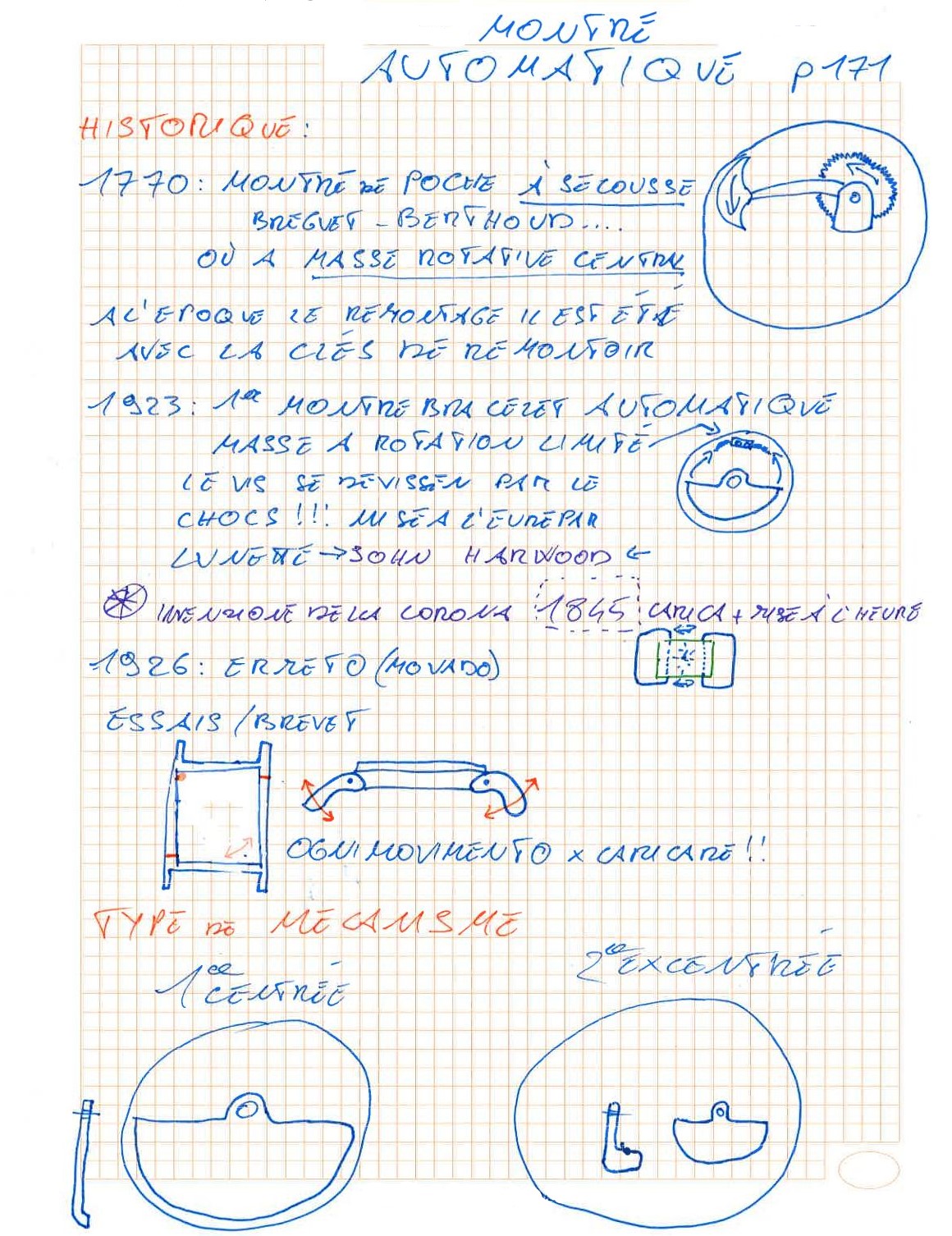
- 1770 — The Origins (Shaking and Perpetual Watches): Initiated by master watchmaker Abraham-Louis Perrelet, then developed by Hubert Sarton, Abraham-Louis Breguet, and the Berthoud brothers. At that time, pocket watch winding was performed using a winding key[cite: 9].
- 1845 — Invention of the Crown: Development of the combined system for manual winding and keyless time-setting[cite: 9].
- 1923 — 1st Automatic Wristwatch (John Harwood): Use of a limited-rotation weight (with bumpers / hammer). Major drawback: micro-screws would unscrew under the repeated effect of shocks. Time-setting was then performed by rotating the bezel[cite: 9].
- 1926 — Movado Ermeto: Introduction of the ingenious sliding-case system where each opening and closing movement winds the mainspring[cite: 9].
📷 ORIGINAL HANDWRITTEN NOTE (01-54) — History & Types of Mechanisms
2. Types of Automatic Winding Mechanisms
- 1° Central Rotor (Suspended Weight):
- Large turning diameter ensuring high winding torque[cite: 9].
- Modular additional mechanism: easy design and adaptable onto a basic mechanical movement[cite: 9].
- Traditional positioning on the bridge side[cite: 9].
- 2° Off-Center Rotor (Micro-Rotor / Integrated Mechanism):
- Emblematic example: the prestigious Patek Philippe 240 caliber[cite: 9].
- Mechanism fully embedded and integrated into the thickness of the mainplate and bridges[cite: 9].
- Oscillating weight struck in 22K Gold (heavy and noble material) to maximize weight and inertia within a restricted diameter[cite: 9].
- Ideal architecture for ultra-thin watches: the weight adds no axial thickness and allows the beauty of the movement to be admired[cite: 9].
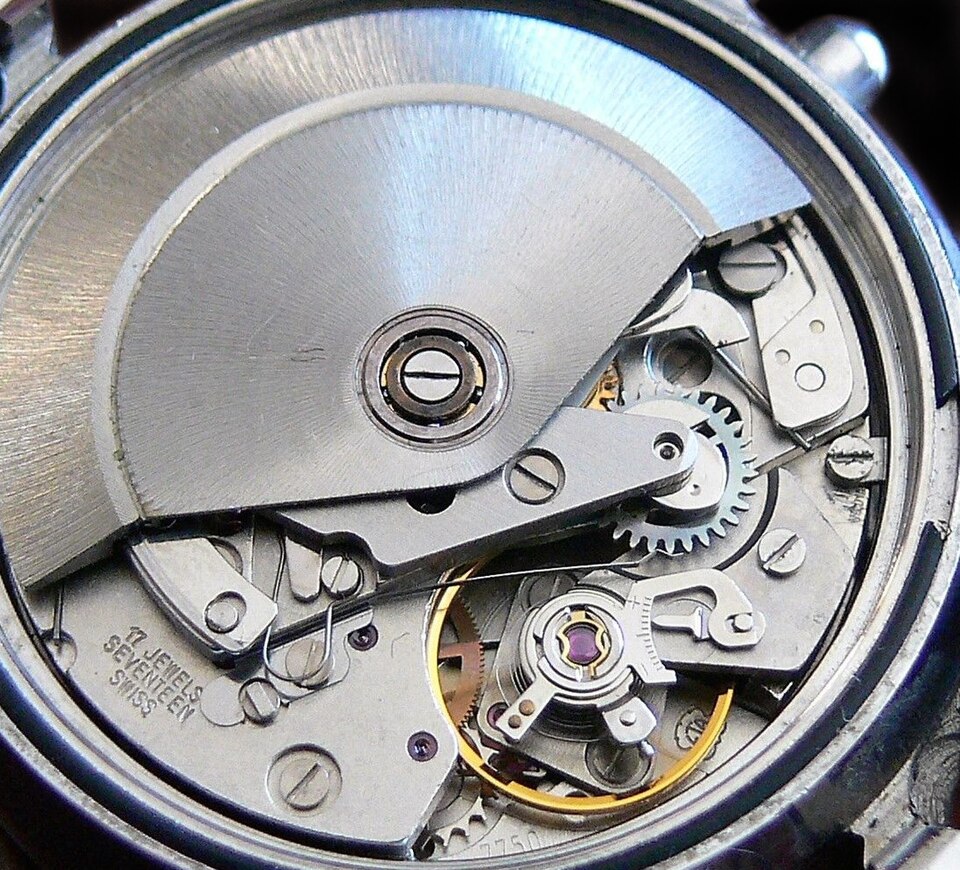
📷 WORKSHOP VIEW — Automatic movement with central oscillating weight on ball bearings and winding gear train[cite: 9].
3. Parts: The Oscillating Weight (Materials & Fastenings)
| Structure | Material | Specifications & Workshop Constraints |
|---|
| A) Monometallic |
22K Gold or Sintered Tungsten |
• 22K Gold: Reserved for ultra-high-end[cite: 9].
• Tungsten: Heavy and dense, but more rigid/brittle[cite: 9]. |
B) Bimetallic
(Industry Standard) |
Brass Center + Outer Tungsten Segment |
• Center (Brass): Flexible and easy to machine[cite: 9].
• Exterior (Tungsten): Offset heavy crown to maximize inertia[cite: 9]. |
🔩 Fastening: Assembly is performed by mechanical crimping, technical screwing/gluing, or precision welding[cite: 9].
4. The Reversers: The Kinematic Core of Winding
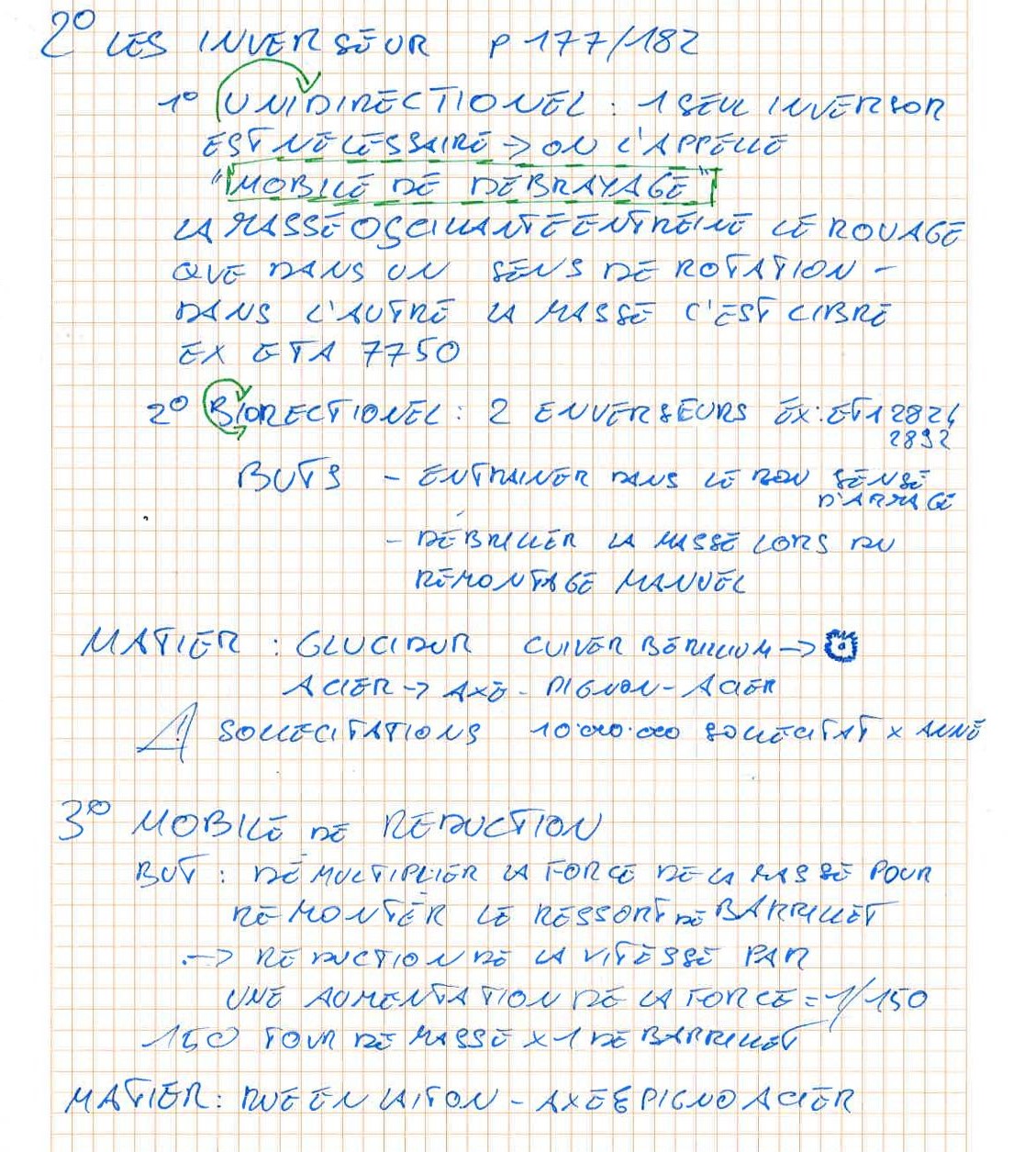
The oscillating weight moves freely in both directions of rotation. However, the mainspring can only be wound in a single direction. The reverser is the mechanism responsible for rectifying this bidirectional motion[cite: 9].
5. Typology and Role of Reversers
Subjected to more than 10 million stresses per year, they must operate with minimal friction[cite: 9].
- Unidirectional System (1 Reverser): The weight drives the gear train in only one direction. In the other, it spins freely. Example: ETA 7750[cite: 9].
- Bidirectional System (2 Reversers): The weight winds the spring regardless of its direction of rotation. Example: ETA 2824-2[cite: 9].
🚴♂️ Workshop Analogy (All-Wheel Drive Bicycle):
When the rotor turns in one direction, one reverser meshes and the other switches to freewheel. When the rotor reverses its course, the roles are reversed. Only one reverser works at a time, which halves direct stresses[cite: 9].
📷 ORIGINAL HANDWRITTEN NOTE — Reversers & Wheels
6. The Reduction Wheel (Gear Reduction)
- The Principle: Rotation speed is reduced to achieve a proportional increase in winding torque[cite: 9].
- The Reduction Ratio (1/150): It takes an average of 150 complete turns of the weight to make the barrel arbor complete 1 single turn[cite: 9].
7. The Automatic Bridge & Manual Disengagement
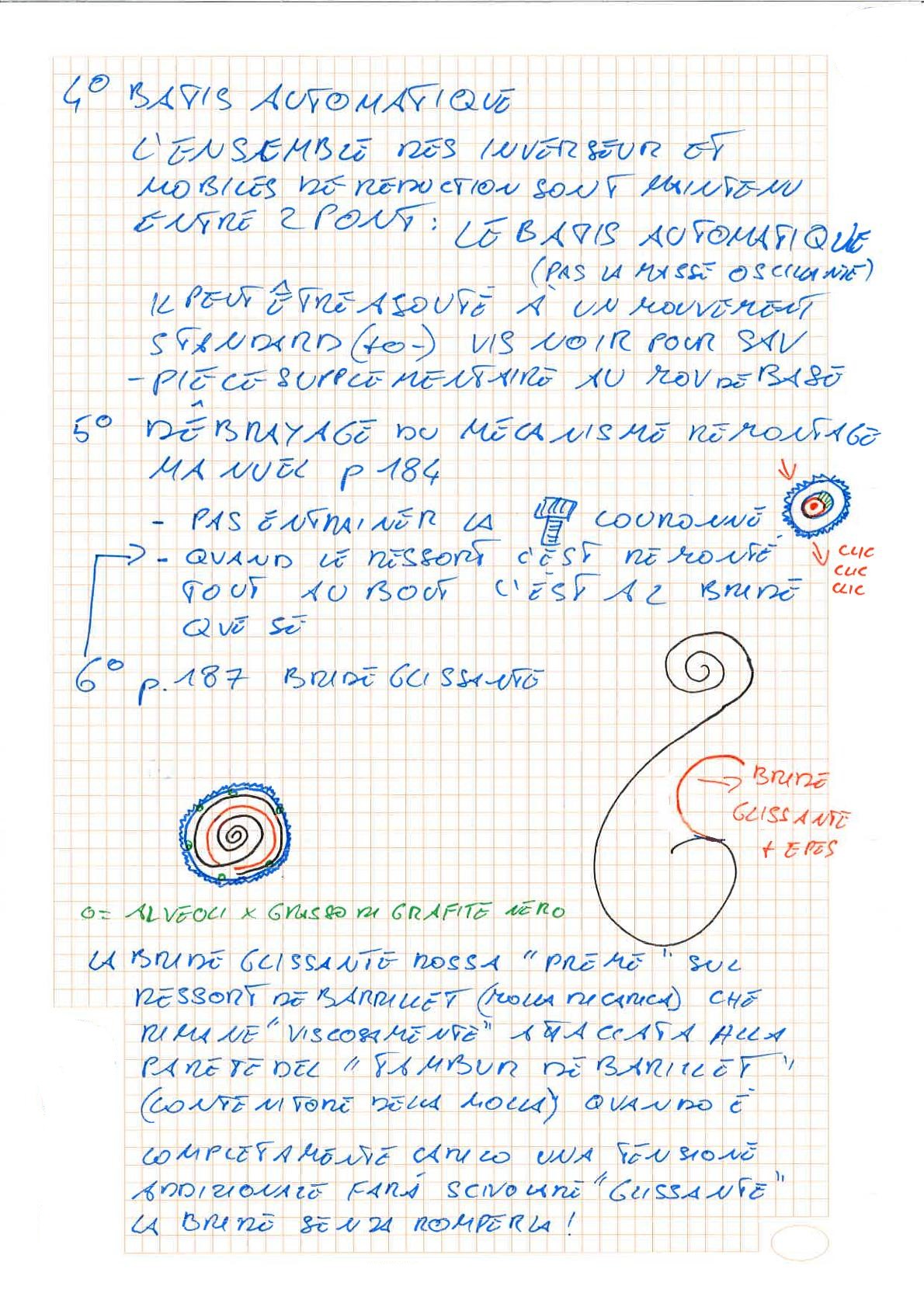
The "Automatic bridge" is the structural module (bridges) that encloses the reversers and reduction. It is often an additional part added to the basic movement[cite: 9].
A safety system isolates the two winding sources[cite: 9]:
- Automatic: Energy goes to the ratchet wheel without turning the crown on the wrist[cite: 9].
- Manual: Force is "disengaged" at the reversers to prevent the weight from spinning at very high speed[cite: 9].
8. Over-tension Safety: The Sliding Bridle
To prevent mainspring breakage when maximum load is reached on the wrist, the Sliding Bridle is used[cite: 9].
- Operation: It is a spring blade fixed to the end of the mainspring that presses against the inner wall of the drum[cite: 9].
- The Slipping (Click Click): The wall features notches coated with black graphite grease. As soon as maximum tension is reached, the bridle "slips" by jumping from recess to recess, dissipating the over-tension[cite: 9].
📷 ORIGINAL HANDWRITTEN NOTE — Automatic Bridge & Sliding Bridle