7. Distribution: The Swiss Lever Escapement
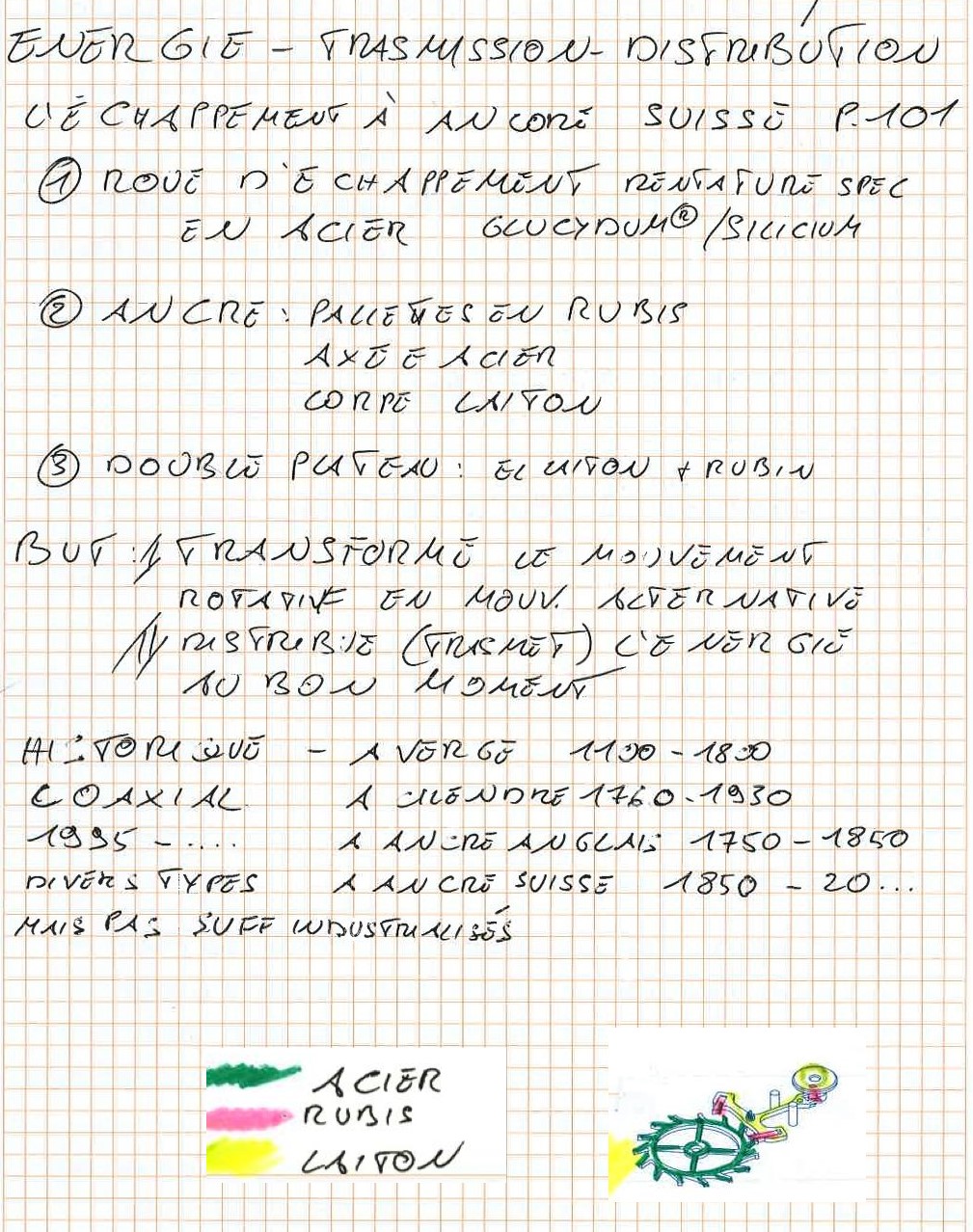
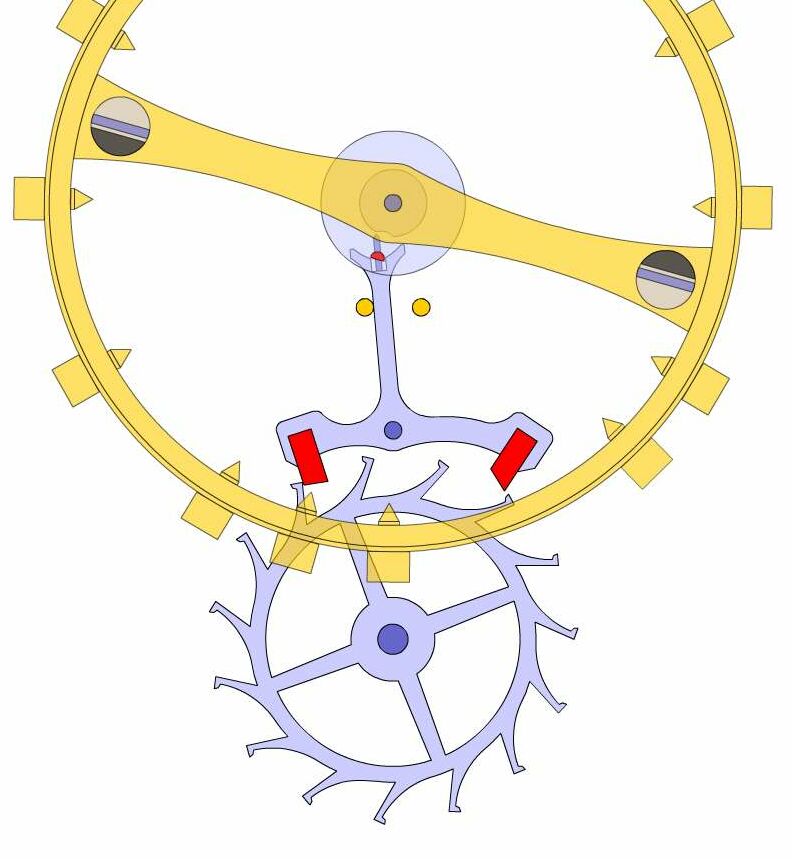
- Key Components: Escape wheel, Swiss lever with pallets (rubies), Double roller with impulse pin (ellipse).
- Function: To transform rotation into oscillations and distribute energy.
1
2
3
4
5
6
7
8
1 Lever body (Corps d'ancre)
2 Entry pallet (Levée d'entrée)
3 Exit pallet (Levée de sortie)
4 Escape wheel (Roue d'échappement)
5 Guard pin (Dard)
6 Fork (Fourchette)
7 Impulse pin / Ellipse (Cheville)
8 Double roller (Double plateau)
📷 ORIGINAL HANDWRITTEN NOTE (01-07) — Swiss Lever Escapement
7B. Technical In-Depth: Functional Anatomy of the Regulating Organ
The regulating organ is the isochronous heart of the mechanical watch. It ensures the rigorous division of time through its regular oscillations. Mastering its sub-assemblies (connections, guides, and impulse) is essential for understanding chronometry.
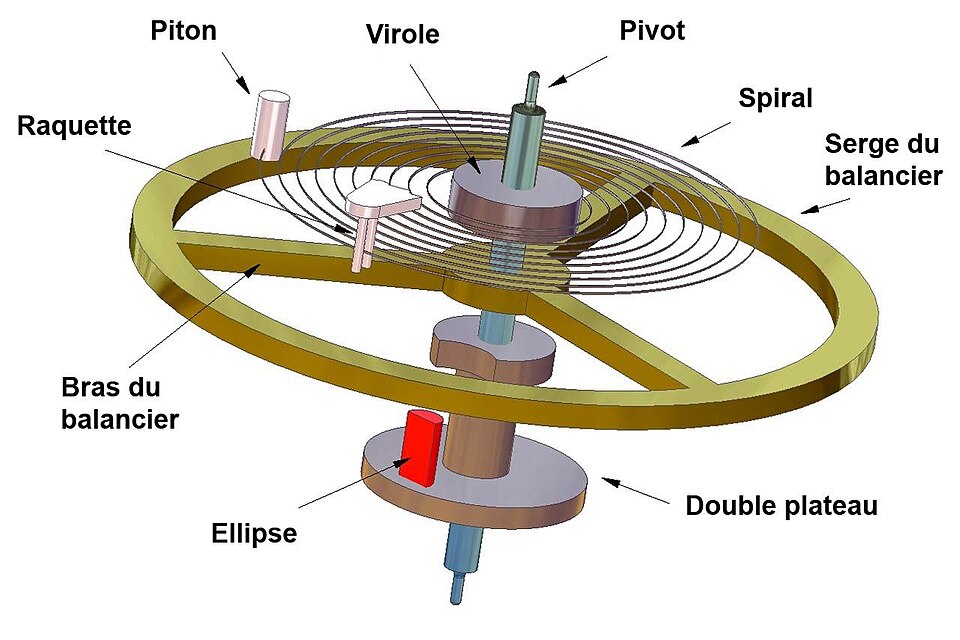
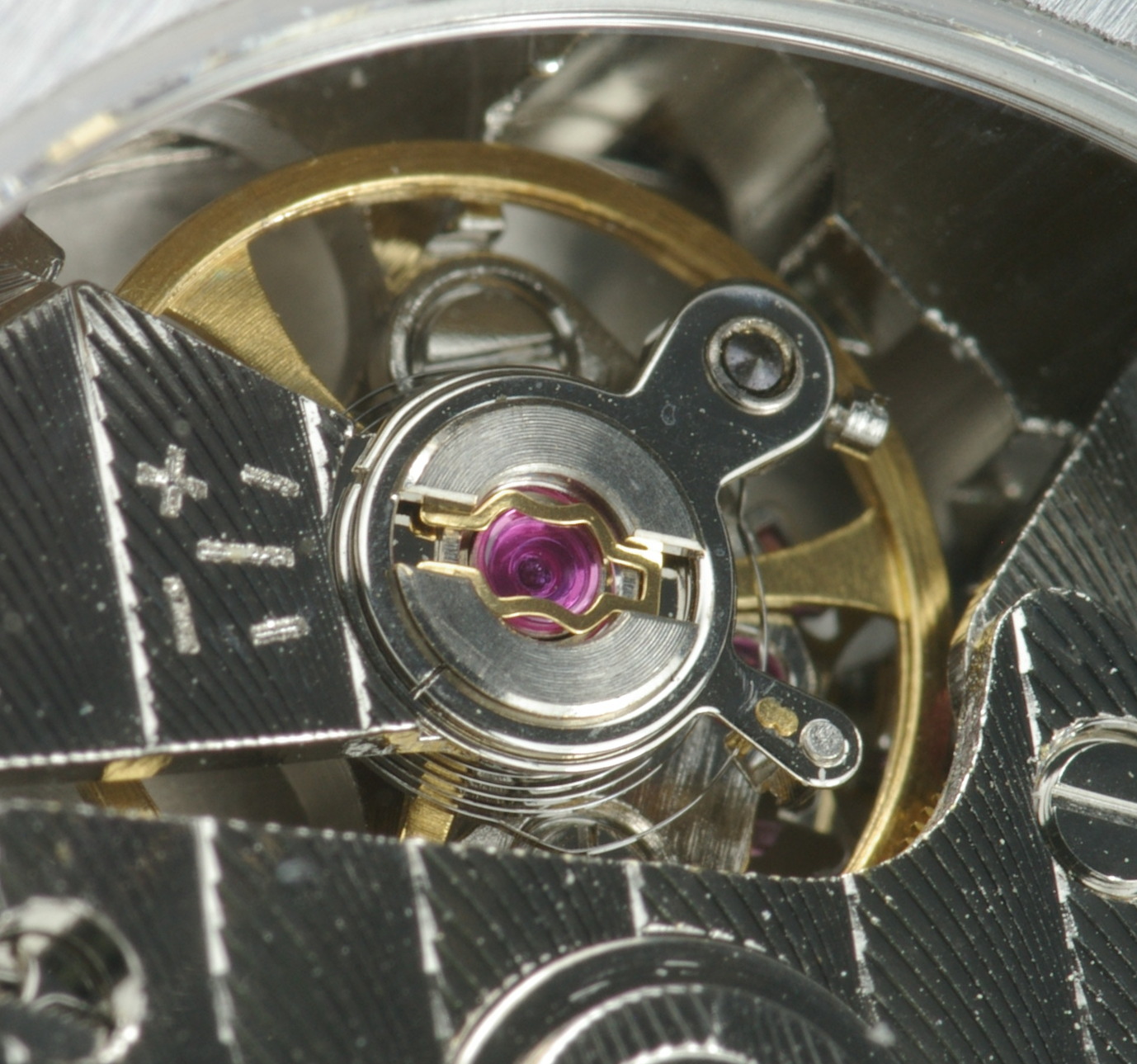
📷 WORKSHOP TECHNICAL BOARD — Functional anatomy of the regulating organ and the balance-spring assembly.
Detailed description of the key components of the balance-spring assembly:
-
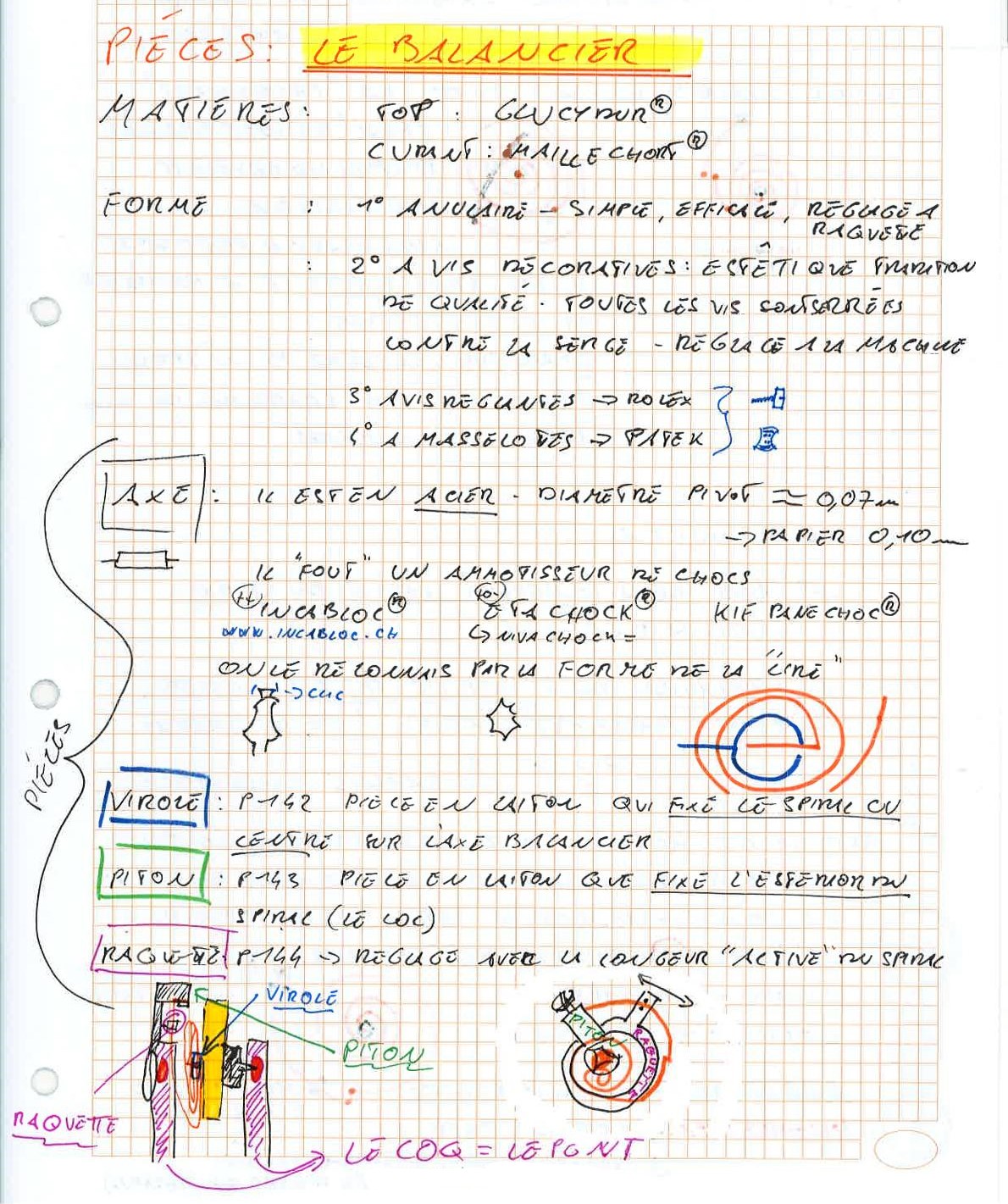
1° The Stud (Piton): It is the fixed anchoring pin that immobilizes the outer end of the balance spring on the balance bridge. It constitutes the external fixed anchor point of the elastic assembly.
-
2° The Collet (Virole): A small central metallic ring micrometrically fitted onto the balance staff, in which the inner end of the spring is fixed and immobilized. It ensures the direct connection between the balance spring and the mobile staff.
-
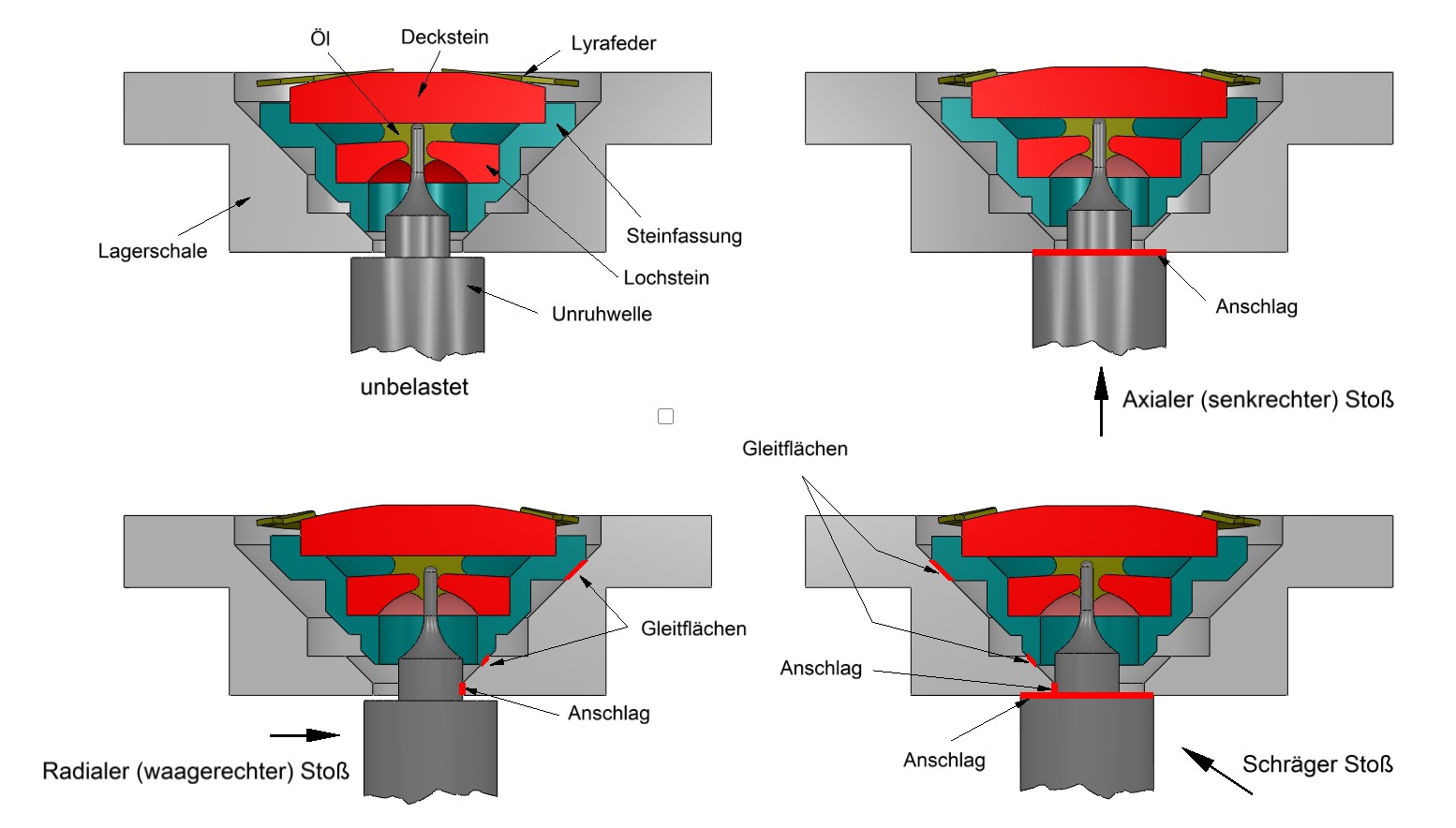
3° The Pivot (Pivot): The extremely fine and polished end of the balance staff. The pivots rotate within rubies (jewel bearings) and undergo extreme mechanical stress in the event of a shock, hence the vital importance of protection systems (Incabloc type).
-
4° The Balance Spring (Spiral): An elastic spring wound in a precise mathematical curve (usually made of a non-magnetic nickel-based alloy or silicon). It provides the permanent elastic restoring torque that constantly returns the balance wheel to its neutral equilibrium position.
-
5° The Balance Rim (Serge du Balancier): The peripheral circular ring of the balance wheel. Its mass and diameter determine the moment of inertia of the part. Dynamic balancing (timing weights or regulating screws) is performed on the rim.
-
6° The Balance Arms (Bras du Balancier): The rigid connecting spokes linking the central hub (or staff) to the outer rim, designed to offer maximum rigidity while minimizing wind resistance and weight.
-
7° The Regulator (Raquette): A mobile regulating organ equipped with two pins between which the balance spring slides. By moving the regulator, the watchmaker changes the active length of the spring, which allows for precise adjustment of the rate (advancing or retarding the watch).
-
8° The Double Roller (Double Plateau): A double disk fitted on the balance staff, including the safety notch and serving as a direct support for the impulse pin.
-
9° The Impulse Pin / Ellipse (Cheville d'impulsion): A small rigid cylinder made of red synthetic ruby firmly planted on the double roller. It is the crucial kinematic contact point: the impulse pin receives the impulse from the lever fork at each oscillation (to maintain the movement) and gives the unlocking impulse to the lever.
⏱️ Isochronous Principle: The oscillation period of the balance-spring assembly depends on its moment of inertia and the stiffness of the spring. Any variation in the active length of the spring (via the regulator) instantly changes the frequency of the watch.
8. Regulation: The Balance-Spring & Oscillation Frequencies
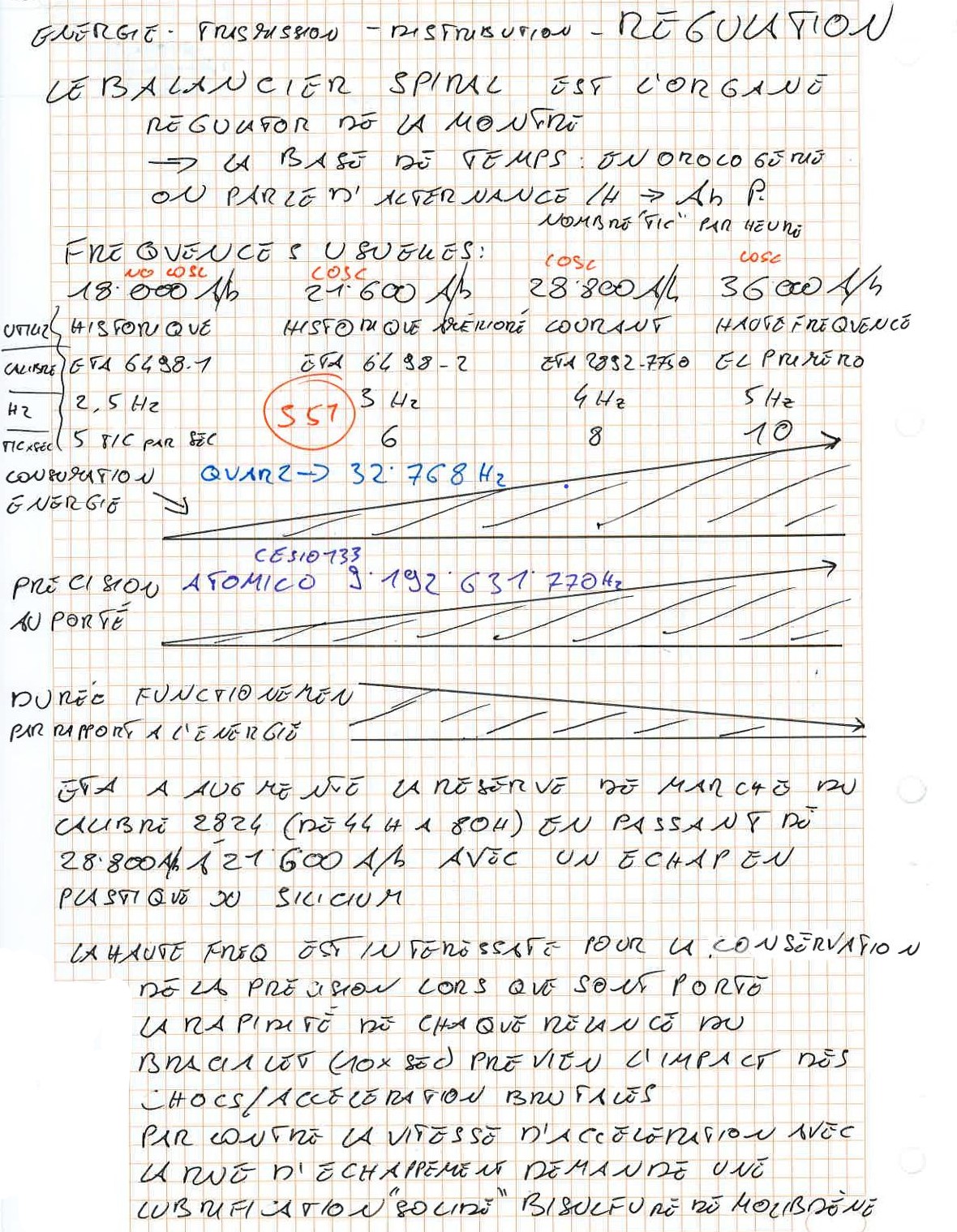
| Frequency (vph) | Caliber Type | Example | (Hz) | Vibrations/Sec |
|---|
| 18,000 vph | Historical / Pocket | ETA 6497-1 | 2.5 Hz | 5 ticks/sec |
| 21,600 vph | Intermediate | ETA 6497-2 | 3.0 Hz | 6 ticks/sec |
| 28,800 vph | Modern Standard | ETA 2824-2 | 4.0 Hz | 8 ticks/sec |
| 36,000 vph | High Frequency | Zenith El Primero | 5.0 Hz | 10 ticks/sec |
📷 ORIGINAL HANDWRITTEN NOTE (01-08) — Balance-Spring
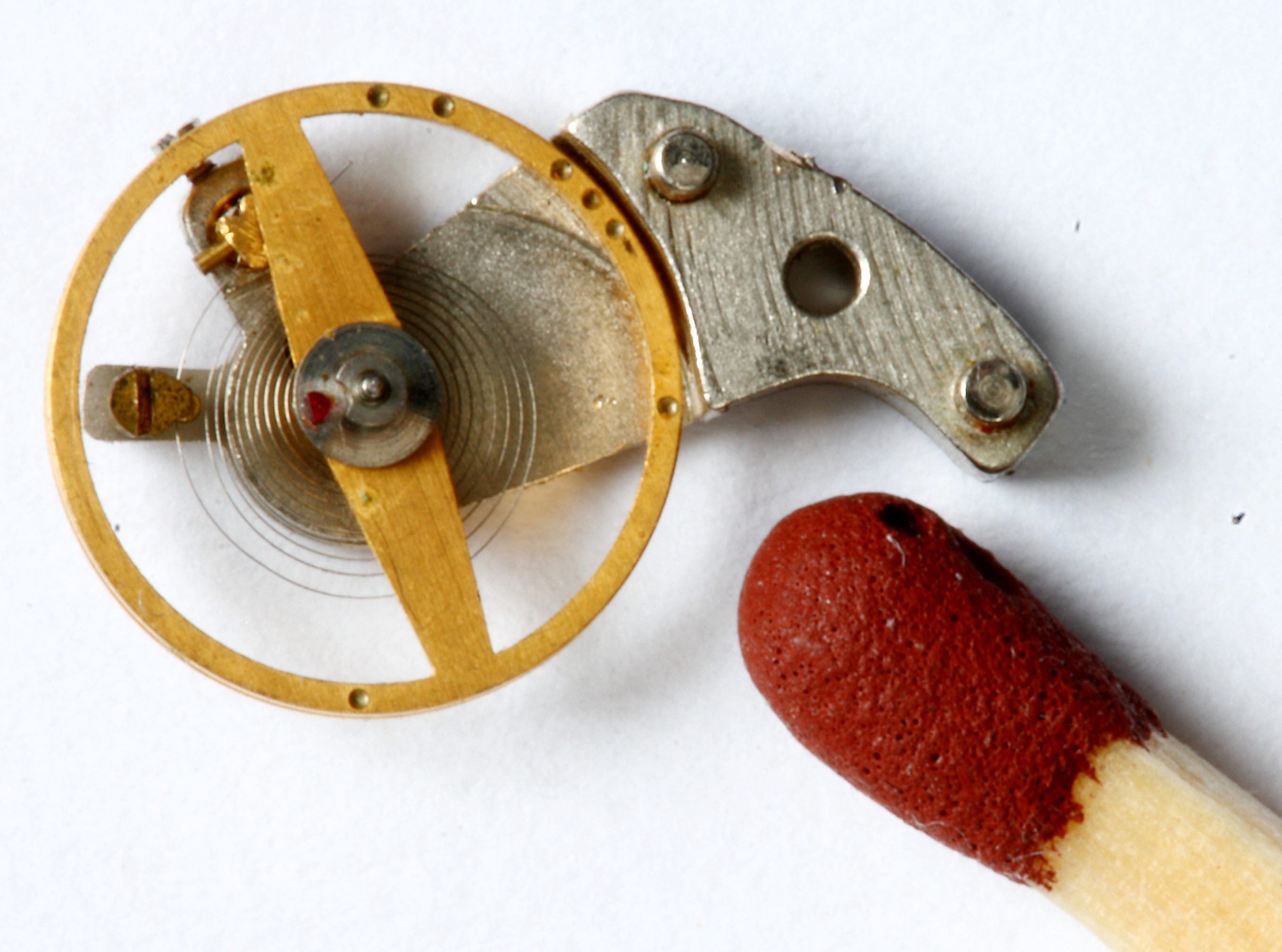
📷 SCALE COMPARISON — The regulating organ (bridge, balance wheel, and spring) next to a match head, illustrating the extreme miniaturization of horological micromechanics.
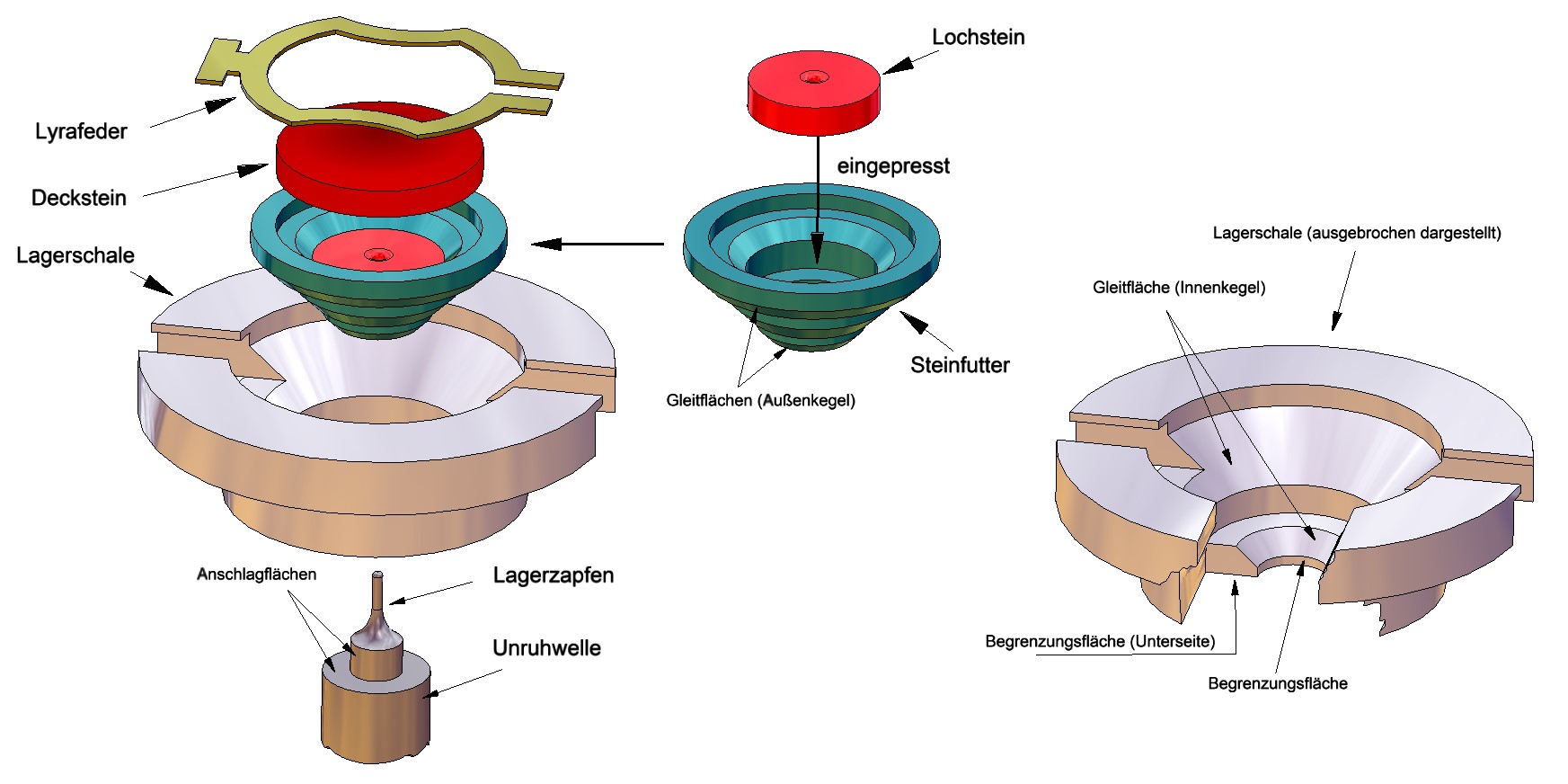
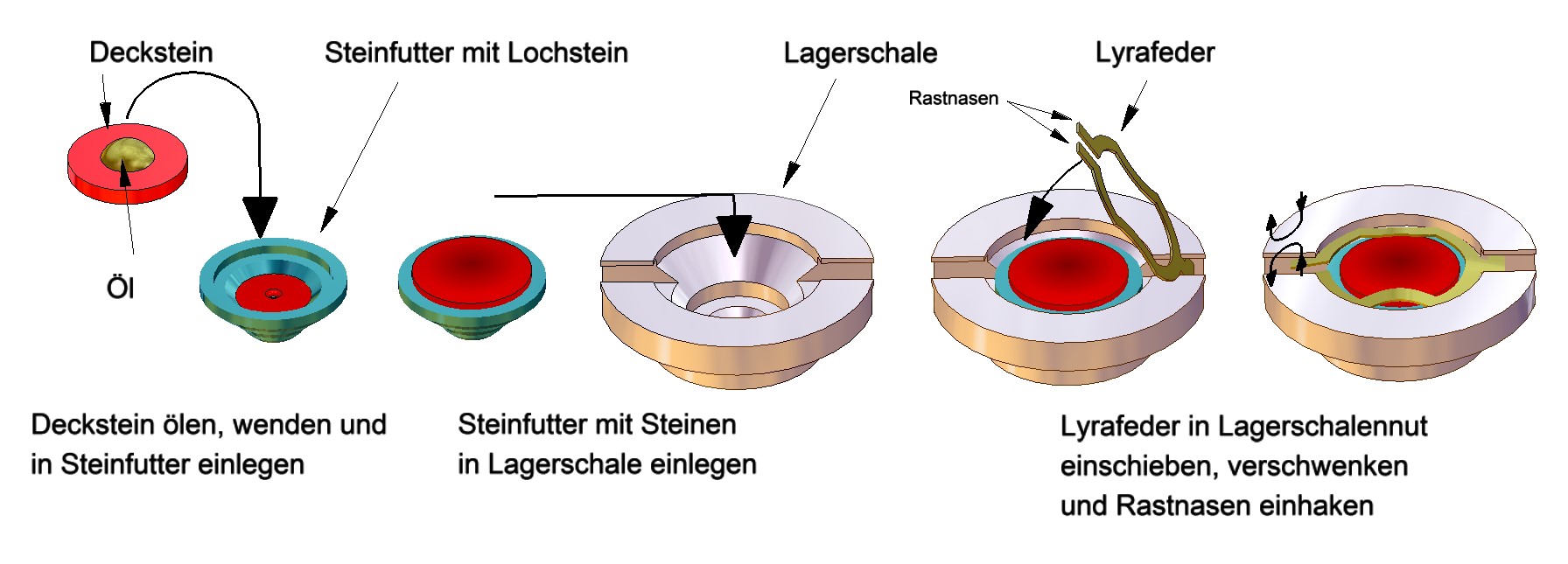
9. Anatomy of the Balance Wheel & Protection Systems (Shock Absorbers)
The major evolution lies in the protection of the pivots (0.07mm) against mechanical shocks.
- Connecting Components: Collet, Stud, Regulator.
📷 ORIGINAL HANDWRITTEN NOTE (01-09) — Balance Wheel Components